

We lost a client in 2022 because their app felt dumb.
Not broken. Not poorly designed. Not slow. Just – dumb. Every user who opened it got the exact same experience. Same homepage layout. Same product order. Same promotional banner that had been sitting there for six weeks because updating it required a developer ticket and a two-week queue.
Their competitor launched six months earlier with something built differently. It remembered what you’d looked at. It adjusted. It felt, somehow, like it was paying attention to you specifically rather than broadcasting at you generically.
The client came to us after losing 30% of their repeat purchase rate in one quarter. They wanted to know what was wrong with their app.
Nothing was wrong with their app. Their app was fine. The problem was that “fine” had stopped being enough – and they hadn’t noticed the moment that happened.
That moment is what this is actually about.
First, Honest About What Traditional Apps Were Good At
Because I don’t want to write another piece that treats every pre-AI product decision like a failure of imagination. It wasn’t.
Traditional apps solved real problems. You could order food, book a cab, pay a bill, manage your schedule – all from your phone. That was genuinely transformative.
Not long ago, none of that existed. The apps that delivered those capabilities were legitimately impressive and genuinely useful.
The logic underneath them was fixed, but fixed logic was fine when the main job was completing a transaction. Book the thing. Pay for the thing. Track the thing. The workflow was predictable, so predefined rules worked.
What changed wasn’t that those apps got worse. What changed was what users started expecting after spending enough time with products that did more.
Once you’ve used something that learns your preferences and adjusts accordingly – really adjusts, not just “here are your recent orders” adjusts – going back to something that treats you identically to every other user feels like a step backward. That feeling, once it exists, doesn’t go away.
And businesses started feeling the consequences of it in their retention numbers.
What “AI-First” Actually Means – Practically, Not Theoretically
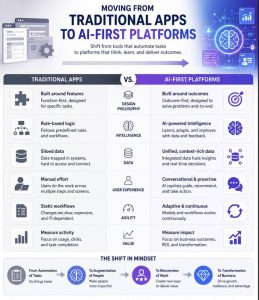
The phrase gets thrown around a lot. Let me try to say what it actually means in practice rather than in a pitch deck.
A traditional app operates on logic that was written before you arrived. Developer defines the rules. Rules run. You interact with the rules. Rules don’t change based on what you do.
An AI-first platform operates differently at the architecture level. The system is built to ingest behavior, update its understanding of what you specifically seem to want, and modify what it shows you and how it responds based on that updated understanding. Continuously.
In the background. Without anyone writing a new rule every time user behavior shifts.
The practical difference is significant. A traditional eCommerce app shows everyone the same product categories because that’s what the developer configured it to show. An AI-first platform is studying – right now, in real time – which categories you engage with, how long you spend on certain products, what you’ve purchased before, where you typically drop off, and adjusting what you see based on all of that combined.
Same interface, visually. Completely different engine underneath.
That difference in engine is why the experiences feel different to users, even when they can’t articulate why.
The Personalization Gap Is Costing Businesses Real Money
I want to be specific here because I think the general conversation about “personalization” has gotten abstract enough that it’s lost its bite.
Here’s what the gap actually looks like in practice.
A mid-sized retail client I worked with was running email campaigns with a 14% open rate. Decent. Not great. Every subscriber received the same email – same subject line, same products, same promotional offer – because their platform didn’t have the capability to segment meaningfully.
They moved to an AI-first platform that personalized subject lines, product selection, and offer type based on individual purchase history and browsing behavior. Within three months, open rate was 31%. Conversion from email nearly doubled.
Same audience. Same products. Different experience of receiving the communication.
That’s not a marginal improvement. That’s the kind of difference that shows up in annual revenue in a way that nobody argues with in a board meeting.
The businesses that haven’t made this shift yet aren’t losing because they’re building bad products. They’re losing because they’re offering generic experiences to users who have spent enough time with personalized ones to find generic experiences genuinely frustrating.
Internal Operations – The Part Nobody Mentions in the Marketing Material
Everything about AI-first platforms gets discussed in terms of user experience. What gets discussed less is what it does internally.
Traditional software requires humans to manage a lot of repetitive analytical work. Someone pulls the weekly report. Someone reviews it. Someone makes decisions based on it. By the time that cycle completes, you’re responding to something that happened ten days ago.
AI-first systems push relevant information to the surface in real time. A customer service team doesn’t wait for end-of-week reporting to know that complaint volume about a specific product is spiking – they know it as it’s happening.
An operations team doesn’t wait for a manual inventory review to flag that a product is trending toward stockout – the system surfaces it before it’s a problem.
That speed of internal awareness compounds over time. Teams that get used to having current information to work from make better decisions faster than teams operating on stale reporting cycles. Not because the people are different. Because the information infrastructure is different.
I’ve watched teams go from monthly operational reviews to daily real-time dashboards and it changes the culture of decision-making in ways that are hard to fully appreciate until you’ve seen it. People stop waiting. They start responding. That shift is genuinely meaningful at scale.
Customer Support Is the Area Where the Old Way Feels Most Broken Now
Because I think this one hits closest to what users actually experience day-to-day.
The scripted chatbot experience – and I say this having built and deployed a few of them, so no judgment – is one of the most reliably frustrating interactions in modern digital life. You type something.
It looks for a keyword. It matches to one of its fifteen scripts. It responds with something that’s adjacent to what you asked but not quite. You try again, slightly differently. It apologizes and offers to connect you with a human. The human is offline. You leave angrier than when you arrived.
We’ve all been there. It’s so common it’s almost a cultural shorthand for bad service.
Current AI-first customer support is different in a specific, important way: it holds context. It understands that your second message is related to your first one. It can follow a conversation that changes direction. It can handle “wait, actually, I meant the other order” without completely resetting.
That sounds like a small thing. It’s not a small thing. The experience of being understood in a support interaction – even by software – versus the experience of being processed through a script is qualitatively different. Users feel it. It affects how they think about the brand.
The best implementations I’ve seen right now use AI to handle the high-volume, lower-complexity interactions and route the genuinely complex or emotionally sensitive ones to human agents with full context already loaded.
Nobody is repeating themselves. The human agent already knows the history. The interaction starts somewhere useful instead of starting from zero.
That combination – AI handling scale, humans handling nuance – is where the best customer experiences are being built right now.
The Scalability Thing – What It Actually Means for Growing Companies
Here’s a real tension that growing businesses hit with traditional apps.
You grow. User volume increases. Every additional user creates more support interactions, more data to process, more operational complexity. To handle it, you hire. To hire, you spend. The cost of serving your users scales roughly linearly with your user base. Sometimes worse than linearly.
AI-first platforms break that relationship – not completely, but meaningfully. Automation handles the portion of operational work that scales with volume.
The AI system managing 10,000 support interactions a day doesn’t require ten times more resources than the one managing 1,000. The personalization engine serving a million users doesn’t require a million-user-sized team to maintain it.
For startups especially, this matters enormously. You can serve a large user base with infrastructure that wouldn’t have been sufficient for that scale five years ago. The ceiling on what a small team can manage has moved significantly.
I’ve seen companies with genuinely lean teams – twelve, fifteen people – running platforms serving hundreds of thousands of active users in ways that simply weren’t possible before AI-first architecture became accessible. That’s not a hypothetical. It’s happening right now, across multiple industries.
The Privacy and Trust Problem – Being Actually Honest
Most articles on this topic have a privacy section that reads like it was drafted by a compliance team. I want to try to say something more specific.
AI-first platforms need data. That’s not incidental – it’s structural. The personalization, the real-time adjustment, the behavioral understanding that makes these platforms better – all of it runs on user data. The more data, the better the system works. That’s just true.
Which means users are in a relationship with these platforms that involves a real exchange: you give us information about how you behave, we give you a better experience.
That exchange can be legitimate and valuable. It can also be exploitative, opaque, and genuinely harmful if the company on the other side isn’t careful or honest about it.
The businesses building trust right now are the ones making that exchange explicit. Here’s what we collect. Here’s what we do with it. Here’s what we don’t do with it. Here’s how to limit it if you want to.
The businesses eroding trust are the ones collecting everything quietly, sharing data in ways users wouldn’t expect if they understood it fully, and treating privacy disclosure as a legal formality rather than a genuine commitment.
Users are getting better at distinguishing between these two approaches. Slowly. But faster than the businesses that haven’t taken it seriously yet seem to realize.
Human Judgment Isn’t Going Anywhere – And I’d Push Back on Anyone Who Suggests Otherwise
There’s a version of the AI-first narrative that I find genuinely misleading, and I want to name it directly.
The idea that these platforms reduce the need for human expertise is wrong in a specific way. They reduce the need for humans to do the mechanical, repetitive, rule-following parts of operational work. They don’t reduce – and in some ways increase – the need for humans to do the judgment-intensive, context-sensitive, ethically complex parts.
Deciding what an AI system should optimize for requires human judgment. Reviewing outputs that will affect customers requires human oversight. Identifying when a system is producing results that are technically correct but contextually wrong requires a person who understands the context.
The companies doing best with AI-first platforms right now are not the ones who deployed AI and reduced headcount. They’re the ones who deployed AI, freed up their people from the mechanical work, and redirected that human capacity toward higher-judgment activities.
That’s a different story than “AI replaces humans.” It’s a more complicated story. Also a more accurate one.
What’s Coming Honest Take, Not the Keynote Version
Traditional apps aren’t disappearing overnight. That’s worth saying plainly because the “everything changes immediately” narrative creates unrealistic expectations.
What’s actually happening is more gradual and more interesting. Most businesses aren’t doing a dramatic overnight rebuild – they’re integrating AI capabilities incrementally, one layer at a time. Some features get smarter.
Some workflows get automated. The teams moving fastest are usually the ones who brought in a top AI development company early to help architect the foundation properly, because retrofitting AI onto a traditional codebase later is significantly messier and more expensive than building with it in mind from the start. Over time those incremental decisions accumulate into something that looks, eventually, quite different from where it started.
The businesses that are navigating this well are making those decisions with a clear sense of where they’re going, even when each individual step is small.
The businesses struggling are adding AI features reactively – responding to what competitors are doing or what sounds impressive in a board presentation – without a coherent architecture underneath it.
The destination seems reasonably clear. Platforms that adapt to individual users in real time, that support faster internal decisions, that scale without proportional cost increases, that handle routine interactions intelligently while preserving human judgment for the things that need it.
Getting there well – securely, responsibly, in ways users actually trust – that’s the work. And it’s more complex than most of the marketing language around it suggests.
The Client From 2022 – What Happened
They rebuilt. Not everything at once – that’s not how this actually works. They started with the recommendation engine and the personalization layer. Fixed the content update problem so the homepage could be dynamic without requiring a developer ticket for every change. Added behavioral segmentation to their communications.
Twelve months later their repeat purchase rate was back. Then higher than it had been before.
Their app still isn’t the most visually impressive thing in their category. Probably won’t ever be. But it pays attention now. It remembers things. It adjusts.
Users feel the difference even when they can’t name it. They just know that this one feels like it gets them and the other one doesn’t.
That feeling – that specific sense of being understood by a product – is what businesses are actually competing for now. The technology is just the mechanism for creating it.
The businesses that understand that are building different things. The ones that don’t are still wondering why “fine” stopped being enough.
Featured image : magnific.com

DigiTechnoPost is a top-rated technology and digital transformation blog where we cover the insightful article about the technology, blogging, WordPress, digital transformation, and digital marketing. We can assist you to digitize your business by providing the best digital transformation & marketing tips. You may follow us on Twitter and Facebook.