
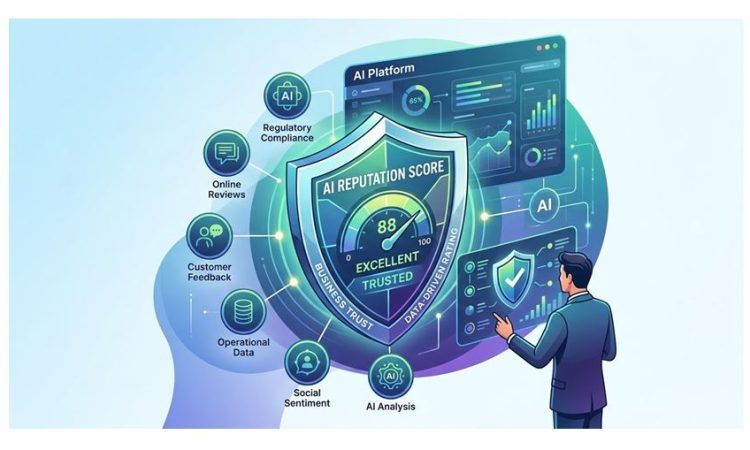
Every business now has a reputation score, whether it knows it or not. AI-driven platforms are quietly aggregating reviews, social signals, and behavioral data to generate a single number that signals trustworthiness to search engines, investors, and potential customers. Understanding how that reputation score is built and what it actually affects is no longer optional for companies that want to stay competitive.
What AI Reputation Scoring Actually Is
AI reputation scoring is the process of collecting signals from dozens of public and private sources, normalizing them into weighted metrics, and producing a quantitative trust score that represents a business’s credibility online.
Platforms like Birdeye, Reputation.com, and Brandwatch aggregate data from more than 50 sources to generate scores on a 0-100 scale, covering roughly 12 million businesses.
Birdeye processes 120 million reviews monthly. Reputation.com monitors more than 200 review sites. Brandwatch analyzes 1.2 billion social mentions daily.
That scale of data ingestion allows platforms to detect patterns most businesses never see when monitoring their own presence manually.
Where the Data Comes From
These scoring systems draw on a wide range of sources. Primary inputs include Google Business Profile data across 340 million locations, 170 million monthly Facebook review contributions, and more than 500 million daily Twitter mentions.
Industry-specific platforms like Yelp, TripAdvisor, and the BBB layer in additional customer feedback. News mentions tracked through the GDELT database add a broader brand perception context.
Citation consistency tools like Moz Local and Yext help verify location accuracy across directories. One important weighting mechanism: signals from the last 90 days receive three times the value of older data points. Recency matters significantly in how platforms assess current credibility.
The platforms normalize 47 distinct signal types across all of this input before any scoring begins.
How the Review Component Gets Calculated
Public reviews feed eight core metrics into scoring algorithms:
- Star rating averages
- Review velocity (posts per 30 days)
- Authenticity scores via tools like Fakespot
- Sentiment polarity (scaled from -1.0 to +1.0)
- Review volume trends
- Response rates
- Complaint ratios
- Verified purchase badges
The weighted formula combines them as follows: average rating contributes 25%, review velocity 20%, authenticity score 20%, response rate 15%, sentiment value 10%, and volume trend 10%.
A business running a 4.3-star average, 47 reviews per month, 89% authenticity, and a 76% response rate would score a 78 out of 100 on the review sub-score alone.
Tools like ReviewMeta and Fakespot detect fraudulent reviews with 94% and 91% accuracy, respectively.
Social Signals and the Reputation Score
Social platforms contribute six weighted signals to the overall reputation score: engagement rate, mention sentiment velocity over 7 days, branded query share, follower growth rate, average response time, and influencer amplification reach.
B2C businesses scoring above the 3.2% industry average engagement receive an additional 12 points on their social sub-score.
A 12,400-follower account with 2.8% engagement, an 18% positive sentiment velocity, and a 4.2-hour average response time represents a typical real-world input scenario.
Real-time monitoring allows reputation scores to shift quickly in response to spikes in negative feedback or sharp increases in positive mentions.
The Algorithms Behind the Score
Modern reputation platforms use ensemble models that combine gradient boosting (XGBoost), neural networks, and rule-based engines.
Reputation.com uses a 347-tree ensemble to evaluate structured data points like review counts and response times.
BERT-based sentiment analysis processes unstructured reviews and social text using a 340-million-parameter model that identifies polarity and aspect-level opinions.
Graph neural networks handle entity linking across 2.3 billion business mentions, connecting related profiles even when a business appears under different names or at different locations.
Temporal decay applies throughout. Signal weight decreases by 50% every 90 days, meaning an old customer complaint carries far less weight than a recent one. Signals older than 180 days receive a substantially reduced contribution to the final score.
The composite score formula: reviews account for 30%, social for 20%, citations for 15%, news for 15%, engagement for 12%, and verification for 8%.
What These Scores Actually Affect
The business impact is measurable. According to BrightLocal’s 2024 Local Consumer Review Survey, businesses with scores above 80 see 47% higher conversion rates from local searches and 3.2 times more partnership inquiries compared to companies scoring below 65.
The score tiers break down practically:
- 90-100: Top 5% visibility, 68% conversion rate
- 80-89: Top 15% visibility, 52% conversion rate
- 70-79: Average visibility, 34% conversion rate
- 60-69: Below average, 21% conversion rate
- Below 60: Penalized visibility tier, 12% conversion rate
Businesses with scores above 75 also receive 34% more local pack impressions than lower-scoring competitors. Search engines incorporate these trust signals directly into ranking decisions.
A Denver-based HVAC company that moved its score from 64 to 83 over eight months recorded a 312% increase in qualified leads from its Google Business Profile.
Reputation Scores in Partnerships and Investment
The threshold effect extends well beyond search rankings. According to Gartner, 63% of enterprise software RFPs in 2024 included algorithmic reputation verification. Venture capital firms and B2B procurement teams now commonly require scores above 75 as a due diligence minimum.
SaaS vendors must meet a minimum score of 78 before enterprise procurement teams will consider a platform. Franchise systems require an 82 or higher for new location approvals. Suppliers scoring below 65 trigger additional audit procedures during risk assessments.
Insurance underwriters offer 12-18% premium discounts to companies scoring above 85. An insurtech startup that dropped from 71 to 58 lost three enterprise contracts and saw a 34% premium increase.
Transparency, Bias, and How Platforms Explain Their Scores
Leading review platforms now show SHAP values and LIME visualizations. These tools reveal which factors contribute to each score.
This change happened faster because of the EU AI Act. The act requires transparency. Some platforms like Trustpilot have a transparency dashboard. For example Trustpilots dashboard shows:
Scores have a range of error. This range is usually three to seven points. It accounts for data. How scores change over time. Companies check for bias every year. They want to make sure some businesses don’t get scores. This could be because of where they’re what they do.
Companies like NetReputation work, with businesses to improve their presence. They see how review scores work and track changes. They check how responding to reviews or being listed consistently affects scores.
Privacy, Regulation, and Compliance Costs
These platforms deal with information from over 340 million people in 47 countries. This means they have to follow the rules set by GDPR Article 22 for automated decision-making and also tell people about their rights under CCPA.
Some important rules these platforms have to follow are:
- They have to delete the information they collect after 90 days but they can keep the scores they calculate from this information for up to three years.
- Every year they have to check if their scoring system’s fair to everyone and does not treat people unfairly.
- They have to give business owners a way to say they do not want their information used in the scoring.
- They have to get permission from the people whose information they are using.
If a platform wants to be GDPR-ready it can cost them between $15,000 and $45,000 every year for the package that helps them follow all the rules. This is a lot more, than the $3,000 to $8,000 they would pay for a scoring tool.
The EU AI Act says that reputation scoring is a high-risk thing that needs to be checked to make sure it is done correctly. If a platform does not follow the rules it can be fined up to EUR35 million or 7% of the money it makes everywhere.
Where Reputation Scoring Is Headed
The next generation of these platforms is really moving quickly. They are working on real-time reputation APIs that can give you information in 15 seconds.
They are also testing models that can forecast scores for the next 90 days and these models are correct about 78 percent of the time.
They were planning to introduce computer vision analysis by the quarter of 2025. This analysis will check how a business looks. If it is open or not by looking at pictures.
They are also testing blockchain-verified review authenticity with the help of the Polygon network programs.
This means they want to make sure reviews are real. They are also working on learning models that will keep information private and make the system more accurate. These models will be available in 2025.
Reputation intelligence market is going to be really big by 2027. It is expected to reach $12.4 billion according to MarketsandMarkets. Companies are building a system to measure how credible a business is and this system is going to be huge.

DigiTechnoPost is a top-rated technology and digital transformation blog where we cover the insightful article about the technology, blogging, WordPress, digital transformation, and digital marketing. We can assist you to digitize your business by providing the best digital transformation & marketing tips. You may follow us on Twitter and Facebook.