

I still think about a specific Friday afternoon.
A recruiter – smart, experienced, genuinely good at her job – sitting at her desk with 340 resumes and a hiring manager who wanted a shortlist before five.
She’d been at it since lunch. I watched her for maybe twenty minutes before I understood what I was actually watching.
Not careful evaluation. Triage.
Ten seconds per resume, maybe less. Eyes moving down the page looking for something – anything – to either keep or discard. The pile she’d almost certainly never return to was growing faster than the one she’d actually read.
By end of day she had eleven names. She pulled me aside afterward and said something I’ve never forgotten: “I have no idea if any of these are actually the best people. I know they’re the ones who used the right words when I still had the energy to notice.”
I’ve told that story in a lot of conversations since then. The response is almost always the same – recognition.
Not surprise. People who’ve worked in hiring know exactly what that afternoon looked like because they’ve lived versions of it themselves.
What’s different now is that there’s actually a better way. And it’s changing not just how fast hiring happens but what the whole thing is for.
The Real Hiring Process – Not the Version Anyone Admits To
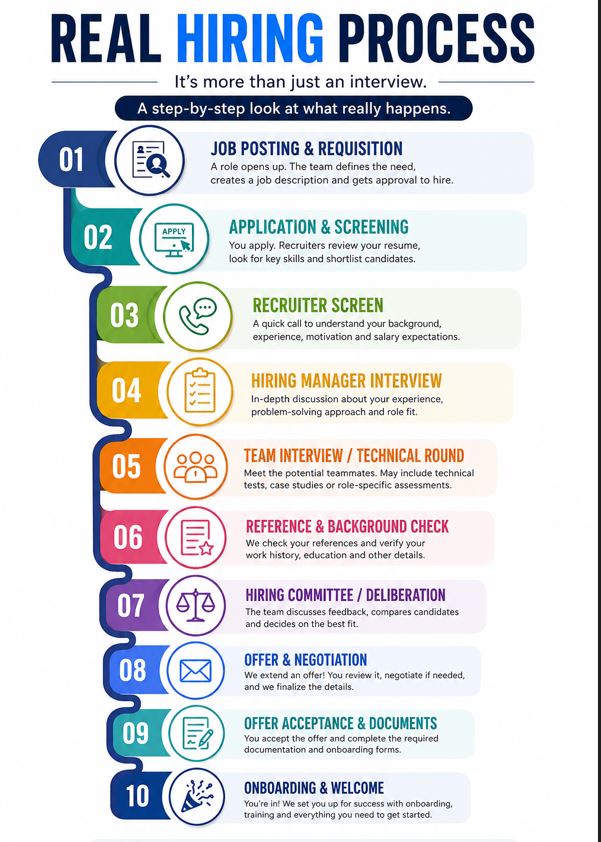
Here’s what I find strange about how hiring gets discussed.
The official version – post a job, review qualified applicants carefully, select the best person – sounds reasonable. Logical, even.
And for small companies with manageable hiring volumes and patient hiring managers, it sometimes actually works that way.
For everyone else? Not really.
Volume is the first problem. A visible job posting at a mid-sized company routinely pulls hundreds of applications.
Nobody designed a process that scales to that. The process that exists was built for fifty applications and got stretched – badly – to handle three hundred.
The second problem is what happens to candidates during this. They submit. They wait. Sometimes they get a form rejection weeks later.
Often they get nothing at all. I’ve spoken with hiring managers who, when I asked what happens to applications after submission, genuinely couldn’t tell me. They just knew that sometimes a recruiter surfaced names and they interviewed them.
That gap – between what applicants experience and what organizations think is happening – isn’t malicious. It’s what happens when a process meets a volume it was never designed for and nobody has rebuilt the process to match reality.
AI is rebuilding the process. That’s the actual story here.
What’s Different About AI Screening – Specifically
Not “AI reads resumes faster.” That’s technically true and also kind of misses the point.
The meaningful difference is what it evaluates.
Human screening is keyword matching. Inconsistent, variable, influenced by the mood of the screener at hour three versus hour one, prone to missing candidates who describe relevant experience in different words than the job posting used.
Someone who spent six years doing essentially the same work as the role requires but calls it something different – that person gets filtered out. Not because they’re unqualified. Because the words didn’t match.
AI pattern recognition is different. It looks at the full picture of what someone has done, not just whether specific terms appear.
It can recognize that adjacent experience is often more predictive of success than exact-match experience. It can surface someone whose path was unconventional but whose actual capabilities fit what the role needs.
I spoke with a talent director last year who described running the same applicant pool through their traditional screening and then through an AI tool.
Three candidates the human process would have discarded got surfaced. All three had non-traditional backgrounds. She interviewed them skeptically, hired two. Both are still there. Both are high performers.
She said: “We would have just missed them. Not because they weren’t good. Because their resumes didn’t look like what we expected.”
That’s the gap AI closes. Not speed – though speed matters too. The gap between what hiring processes are designed to find and what actually makes someone good at a job.
Predictive Hiring – Less Scary Than It Sounds, More Useful Than It Gets Credit For
This one makes people nervous when described abstractly. “AI predicting who will succeed” has an unsettling ring to it.
In practice it’s considerably less mysterious.
Every organization has years of data sitting unused. Who got hired for which roles. How those people performed. What their backgrounds looked like.
What patterns show up consistently in the people who stayed, grew, and contributed – versus the ones who churned out in year one or quietly underperformed.
Most companies have never looked at that data systematically. Not because they don’t want to – because doing it manually is genuinely hard and nobody has had time.
AI can surface those patterns. And once you understand that a particular combination of experiences has historically predicted strong outcomes in a specific function at your company – that’s real information. Not a guarantee. A signal worth including in your evaluation.
The caveat matters enormously though, and I want to say it plainly: if your historical hiring was biased – favoring certain schools, certain backgrounds, certain demographics for reasons unrelated to job performance – a predictive model trained on that history will reproduce those biases. It won’t announce itself as biased. It will just keep producing the same skewed outputs until someone audits it carefully enough to notice.
This isn’t a theoretical risk. There are documented cases. The companies doing this responsibly are auditing outputs continuously, not once at setup.
What Job Seekers Are Actually Feeling
The candidate experience in traditional hiring has been bad for so long that people have mostly stopped expecting it to be otherwise.
You apply. You wait. If you’re lucky you get a form email eventually. If you’re not, you just never hear anything.
The company has all the information – your resume, your work history, your time. You have nothing except the knowledge that your application is somewhere in a queue.
That asymmetry is genuinely awful. And it has real consequences beyond being unpleasant.
I’ve talked to people who removed companies from their list entirely based on how an application process felt – not a rejection, just the experience of being treated like your time and attention were irrelevant.
I’ve also talked to people who remained fans of companies that rejected them because the process felt respectful. They referred friends. They applied again when a better role opened.
AI-powered recruitment doesn’t fix this automatically. But implemented well, it does two things that matter: it responds faster because it’s not waiting on a human’s bandwidth, and it personalizes those responses because it knows where each candidate is in the process rather than sending a single generic update to everyone.
The difference between “we received your application” and “we’ve reviewed your application and here’s what happens next” is not technically impressive. But experientially it’s significant. People feel like someone actually saw them.
The Passive Candidate Question
Most of the people who’d be good at a role aren’t looking for it.
That’s just true. Most qualified people at any given moment are employed somewhere and not actively browsing job boards.
They might be open to a conversation if approached thoughtfully – but they’re not coming to you through a posting.
Traditional recruiting was almost entirely dependent on that self-selected group of active searchers. Which means it was always missing most of the population it theoretically wanted to reach.
AI tools that analyze professional networks, skills data, and career trajectory patterns can identify people in that passive pool who match what you’re looking for.
Not perfectly. Not without a human recruiter then making a judgment about whether outreach makes sense.
But the initial identification – finding people who exist and have relevant backgrounds – that part can now be done at a scale and with a comprehensiveness that no team of human sourcers could match.
For specialized roles where genuinely qualified candidates are scarce, this is not a marginal improvement.
It’s often the difference between filling a role and leaving it open for six months. I’ve watched early-stage companies especially struggle with this – they don’t have the brand recognition to pull passive candidates through a posting alone, and they can’t afford the retainer model of a traditional executive search firm.
What’s worked for some of them is partnering with a best recruitment agency for startups that has already built AI-assisted sourcing into their process, so the passive candidate identification work happens without requiring the company to build that infrastructure themselves. Not every team has the runway to figure this out from scratch while also trying to ship product.
Why Speed Is Actually More Important Than It Seems
Every hiring team I’ve spoken with lists speed as a top benefit of AI tools. I used to dismiss this slightly – of course faster is better, that’s not an interesting observation.
I’ve revised that.
The actual cost of slow hiring isn’t really the productivity loss from an unfilled seat, though that’s real. It’s candidate loss. Good candidates move. They have other processes running. They’re not holding an offer waiting to see if you get back to them in six weeks.
A VP of engineering told me last year they’d lost three strong candidates in a single quarter to a competitor. Not because the competitor paid more or had a better product or a more interesting mission. Because the competitor’s process was three weeks faster and the candidates weren’t willing to wait.
Three people. One quarter. Because of scheduling lag and screening bottlenecks that AI tools would have removed.
When you frame speed that way – not as an efficiency metric but as a retention-of-interest metric – it becomes considerably more important. Faster doesn’t just mean cheaper to operate. In competitive talent markets, faster often just means winning.
The Bias Section – Which Most Articles Underwrite
I’m going to spend more time here than most pieces do because I think the usual treatment is too thin.
The optimistic case: AI removes human inconsistency and mood-dependency from evaluation. Same candidate, same criteria, same output – regardless of whether the screener is having a good day or whether the candidate’s name sounds familiar or not.
The realistic complication: AI learns from data. The data is historical hiring decisions. Historical hiring decisions were, in many cases, biased in ways that were never acknowledged or corrected.
A system that learns from those decisions will learn those biases too – and will reproduce them at scale, consistently, without anyone in the loop to catch the pattern.
This has happened. It’s not hypothetical. Amazon built and then quietly shelved a recruiting tool after discovering it had learned to penalize resumes that included the word “women’s” – because it had trained on hiring data from a predominantly male engineering organization.
The companies doing this well don’t treat bias auditing as something you do once before launch. They treat it as an ongoing operational function.
Regular testing for disparate impact across demographic groups. Human review for any consequential decision. Transparency with candidates about what role AI plays in their evaluation.
The companies doing this poorly deploy the tool, trust the outputs, and find out there’s a problem when someone files a complaint or a journalist runs the numbers.
The gap in outcomes between those two approaches is significant. And increasingly it’s a legal gap, not just an ethical one.
What Recruiters Are Actually Doing Now
The replacement narrative hasn’t played out. What’s played out instead is more interesting.
Recruiters at organizations using these tools well are doing genuinely different work. The volume processing – the four-hour Friday afternoon – is handled by the system. What’s left is the work that was always supposed to be at the center of recruiting and kept getting crowded out by logistics.
Relationship building. Real conversations with candidates about what they actually want and whether this role and company is actually the right fit for them – not just whether their resume matches the job description. Strategic thinking about how to build the team the organization needs over the next few years, not just how to fill the opening in front of you.
A recruiter I spoke with described finally feeling like she was doing the job she trained for. Years of “logistics and filtering” – her words – and now most of her time goes to conversations. With candidates, with hiring managers, on questions that require actual judgment.
That’s not a smaller job. That’s a better one.
The Honest Advice Part
If you’re building or rebuilding a hiring process right now – a few things worth saying directly.
Don’t implement AI tools because it seems like the thing to do. Implement them because you have a specific problem you understand clearly and have reason to believe these tools address. Vague modernization is not a good enough reason to overhaul a process people depend on.
Do the bias work early. Before you’re under external pressure to do it. It is significantly harder to retrofit fairness evaluation into a process that’s already running than to build it in from the start.
Keep humans in meaningful decision loops. AI surfacing candidates and accelerating screening – fine. AI making consequential decisions without human review – not fine, and increasingly not legally defensible.
Take candidate experience seriously as a measure of success, not an afterthought. Every person who goes through your process forms an impression of your organization. AI done carelessly can make that impression worse than a slow, manual process ever did. AI done thoughtfully can make it meaningfully better.
That Friday Afternoon, Revisited
I talked to her again not long ago.
Different company. One that had been using AI-assisted screening for about a year and a half. I asked what was different.
She said she hadn’t done a manual resume review in over a year. That candidates arrive to her having already been evaluated for basic fit, and she’s working from a pool that makes sense rather than sorting through volume to find the people worth talking to.
She spends her days on conversations now. Figuring out who someone actually is, what they want, whether this is genuinely right for them – not just whether their keywords matched.
“I feel like I’m actually recruiting,” she said. “Before I was just sorting.”
I’ve thought about that sentence a lot since.
The technology changed how she spends her time. How she spends her time changed what she understands her job to be. Those are two different changes and both of them matter.
The second one – the identity shift, from sorter to recruiter – that’s what good implementation of these tools actually produces. Not humans removed from the picture. Humans doing more of what only humans can do, because something else is handling the part that never really needed a human in the first place.
Featured image : magnific.com

DigiTechnoPost is a top-rated technology and digital transformation blog where we cover the insightful article about the technology, blogging, WordPress, digital transformation, and digital marketing. We can assist you to digitize your business by providing the best digital transformation & marketing tips. You may follow us on Twitter and Facebook.